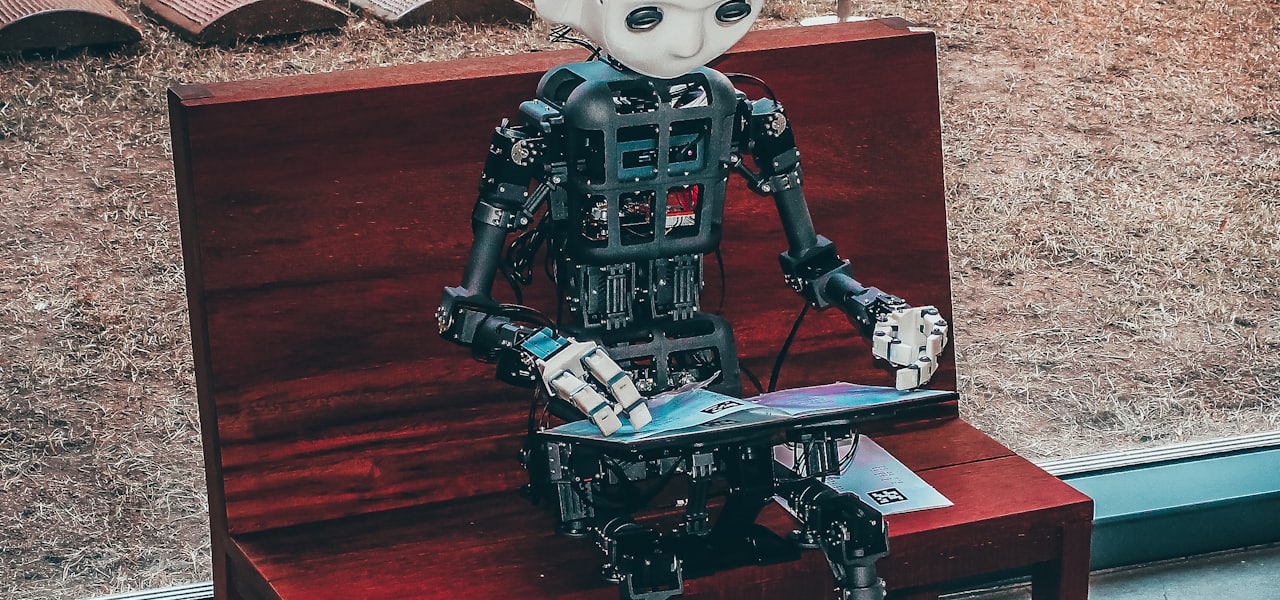
Bayesian programming is a formalism and a methodology for having a technique to specify probabilistic models and solve problems when less than the necessary information is available. Edwin T. Jaynes proposed that probability could be considered as an alternative and an extension of logic for rational reasoning with incomplete and uncertain information. In his founding book Probability Theory: The Logic of Science he developed this theory and proposed what he called "the robot," which was not a physical device, but an inference engine to automate probabilistic reasoning—a kind of Prolog for probability instead of logic. Bayesian programming is a formal and concrete implementation of this "robot". Bayesian programming may also be seen as an algebraic formalism to specify graphical models such as, for instance, Bayesian networks, dynamic Bayesian networks, Kalman filters or hidden Markov models. Indeed, Bayesian programming is more general than Bayesian networks and has a power of expression equivalent to probabilistic factor graphs. == Formalism == A Bayesian program is a means of specifying a family of probability distributions. The constituent elements of a Bayesian program are presented below: Program { Description { Specification ( π ) { Variables Decomposition Forms Identification (based on δ ) Question {\displaystyle {\text{Program}}{\begin{cases}{\text{Description}}{\begin{cases}{\text{Specification}}(\pi ){\begin{cases}{\text{Variables}}\\{\text{Decomposition}}\\{\text{Forms}}\\\end{cases}}\\{\text{Identification (based on }}\delta )\end{cases}}\\{\text{Question}}\end{cases}}} A program is constructed from a description and a question. A description is constructed using some specification ( π {\displaystyle \pi } ) as given by the programmer and an identification or learning process for the parameters not completely specified by the specification, using a data set ( δ {\displaystyle \delta } ). A specification is constructed from a set of pertinent variables, a decomposition and a set of forms. Forms are either parametric forms or questions to other Bayesian programs. A question specifies which probability distribution has to be computed. === Description === The purpose of a description is to specify an effective method of computing a joint probability distribution on a set of variables { X 1 , X 2 , ⋯ , X N } {\displaystyle \left\{X_{1},X_{2},\cdots ,X_{N}\right\}} given a set of experimental data δ {\displaystyle \delta } and some specification π {\displaystyle \pi } . This joint distribution is denoted as: P ( X 1 ∧ X 2 ∧ ⋯ ∧ X N ∣ δ ∧ π ) {\displaystyle P\left(X_{1}\wedge X_{2}\wedge \cdots \wedge X_{N}\mid \delta \wedge \pi \right)} . To specify preliminary knowledge π {\displaystyle \pi } , the programmer must undertake the following: Define the set of relevant variables { X 1 , X 2 , ⋯ , X N } {\displaystyle \left\{X_{1},X_{2},\cdots ,X_{N}\right\}} on which the joint distribution is defined. Decompose the joint distribution (break it into relevant independent or conditional probabilities). Define the forms of each of the distributions (e.g., for each variable, one of the list of probability distributions). ==== Decomposition ==== Given a partition of { X 1 , X 2 , … , X N } {\displaystyle \left\{X_{1},X_{2},\ldots ,X_{N}\right\}} containing K {\displaystyle K} subsets, K {\displaystyle K} variables are defined L 1 , ⋯ , L K {\displaystyle L_{1},\cdots ,L_{K}} , each corresponding to one of these subsets. Each variable L k {\displaystyle L_{k}} is obtained as the conjunction of the variables { X k 1 , X k 2 , ⋯ } {\displaystyle \left\{X_{k_{1}},X_{k_{2}},\cdots \right\}} belonging to the k t h {\displaystyle k^{th}} subset. Recursive application of Bayes' theorem leads to: P ( X 1 ∧ X 2 ∧ ⋯ ∧ X N ∣ δ ∧ π ) = P ( L 1 ∧ ⋯ ∧ L K ∣ δ ∧ π ) = P ( L 1 ∣ δ ∧ π ) × P ( L 2 ∣ L 1 ∧ δ ∧ π ) × ⋯ × P ( L K ∣ L K − 1 ∧ ⋯ ∧ L 1 ∧ δ ∧ π ) {\displaystyle {\begin{aligned}&P\left(X_{1}\wedge X_{2}\wedge \cdots \wedge X_{N}\mid \delta \wedge \pi \right)\\={}&P\left(L_{1}\wedge \cdots \wedge L_{K}\mid \delta \wedge \pi \right)\\={}&P\left(L_{1}\mid \delta \wedge \pi \right)\times P\left(L_{2}\mid L_{1}\wedge \delta \wedge \pi \right)\times \cdots \times P\left(L_{K}\mid L_{K-1}\wedge \cdots \wedge L_{1}\wedge \delta \wedge \pi \right)\end{aligned}}} Conditional independence hypotheses then allow further simplifications. A conditional independence hypothesis for variable L k {\displaystyle L_{k}} is defined by choosing some variable X n {\displaystyle X_{n}} among the variables appearing in the conjunction L k − 1 ∧ ⋯ ∧ L 2 ∧ L 1 {\displaystyle L_{k-1}\wedge \cdots \wedge L_{2}\wedge L_{1}} , labelling R k {\displaystyle R_{k}} as the conjunction of these chosen variables and setting: P ( L k ∣ L k − 1 ∧ ⋯ ∧ L 1 ∧ δ ∧ π ) = P ( L k ∣ R k ∧ δ ∧ π ) {\displaystyle P\left(L_{k}\mid L_{k-1}\wedge \cdots \wedge L_{1}\wedge \delta \wedge \pi \right)=P\left(L_{k}\mid R_{k}\wedge \delta \wedge \pi \right)} We then obtain: P ( X 1 ∧ X 2 ∧ ⋯ ∧ X N ∣ δ ∧ π ) = P ( L 1 ∣ δ ∧ π ) × P ( L 2 ∣ R 2 ∧ δ ∧ π ) × ⋯ × P ( L K ∣ R K ∧ δ ∧ π ) {\displaystyle {\begin{aligned}&P\left(X_{1}\wedge X_{2}\wedge \cdots \wedge X_{N}\mid \delta \wedge \pi \right)\\={}&P\left(L_{1}\mid \delta \wedge \pi \right)\times P\left(L_{2}\mid R_{2}\wedge \delta \wedge \pi \right)\times \cdots \times P\left(L_{K}\mid R_{K}\wedge \delta \wedge \pi \right)\end{aligned}}} Such a simplification of the joint distribution as a product of simpler distributions is called a decomposition, derived using the chain rule. This ensures that each variable appears at the most once on the left of a conditioning bar, which is the necessary and sufficient condition to write mathematically valid decompositions. ==== Forms ==== Each distribution P ( L k ∣ R k ∧ δ ∧ π ) {\displaystyle P\left(L_{k}\mid R_{k}\wedge \delta \wedge \pi \right)} appearing in the product is then associated with either a parametric form (i.e., a function f μ ( L k ) {\displaystyle f_{\mu }\left(L_{k}\right)} ) or a question to another Bayesian program P ( L k ∣ R k ∧ δ ∧ π ) = P ( L ∣ R ∧ δ ^ ∧ π ^ ) {\displaystyle P\left(L_{k}\mid R_{k}\wedge \delta \wedge \pi \right)=P\left(L\mid R\wedge {\widehat {\delta }}\wedge {\widehat {\pi }}\right)} . When it is a form f μ ( L k ) {\displaystyle f_{\mu }\left(L_{k}\right)} , in general, μ {\displaystyle \mu } is a vector of parameters that may depend on R k {\displaystyle R_{k}} or δ {\displaystyle \delta } or both. Learning takes place when some of these parameters are computed using the data set δ {\displaystyle \delta } . An important feature of Bayesian programming is this capacity to use questions to other Bayesian programs as components of the definition of a new Bayesian program. P ( L k ∣ R k ∧ δ ∧ π ) {\displaystyle P\left(L_{k}\mid R_{k}\wedge \delta \wedge \pi \right)} is obtained by some inferences done by another Bayesian program defined by the specifications π ^ {\displaystyle {\widehat {\pi }}} and the data δ ^ {\displaystyle {\widehat {\delta }}} . This is similar to calling a subroutine in classical programming and provides an easy way to build hierarchical models. === Question === Given a description (i.e., P ( X 1 ∧ X 2 ∧ ⋯ ∧ X N ∣ δ ∧ π ) {\displaystyle P\left(X_{1}\wedge X_{2}\wedge \cdots \wedge X_{N}\mid \delta \wedge \pi \right)} ), a question is obtained by partitioning { X 1 , X 2 , ⋯ , X N } {\displaystyle \left\{X_{1},X_{2},\cdots ,X_{N}\right\}} into three sets: the searched variables, the known variables and the free variables. The 3 variables S e a r c h e d {\displaystyle Searched} , K n o w n {\displaystyle Known} and F r e e {\displaystyle Free} are defined as the conjunction of the variables belonging to these sets. A question is defined as the set of distributions: P ( S e a r c h e d ∣ Known ∧ δ ∧ π ) {\displaystyle P\left(Searched\mid {\text{Known}}\wedge \delta \wedge \pi \right)} made of many "instantiated questions" as the cardinal of K n o w n {\displaystyle Known} , each instantiated question being the distribution: P ( Searched ∣ Known ∧ δ ∧ π ) {\displaystyle P\left({\text{Searched}}\mid {\text{Known}}\wedge \delta \wedge \pi \right)} === Inference === Given the joint distribution P ( X 1 ∧ X 2 ∧ ⋯ ∧ X N ∣ δ ∧ π ) {\displaystyle P\left(X_{1}\wedge X_{2}\wedge \cdots \wedge X_{N}\mid \delta \wedge \pi \right)} , it is always possible to compute any possible question using the following general inference: P ( Searched ∣ Known ∧ δ ∧ π ) = ∑ Free [ P ( Searched ∧ Free ∣ Known ∧ δ ∧ π ) ] = ∑ Free [ P ( Searched ∧ Free ∧ Known ∣ δ ∧ π ) ] P ( Known ∣ δ ∧ π ) = ∑ Free [ P ( Searched ∧ Free ∧ Known ∣ δ ∧ π ) ] ∑ Free ∧ Searched [ P ( Searched ∧ Free ∧ Known ∣ δ ∧ π ) ] = 1 Z × ∑ Free [ P ( Searched ∧ Free ∧ Known ∣ δ ∧ π ) ] {\displaystyle {\begin{aligned}&P\left({\text{Searched}}\mid {\text{Known}}\wedge \delta \wedge \pi \right)\\={}&\sum _{\text{Free}}\left[P\left({\text{Searched}}\wedge {\text{Free}}\mid {\text{Known}}\wedge \delta \wedge \
Spreading activation
Spreading activation is a method for searching associative networks, biological and artificial neural networks, or semantic networks. The search process is initiated by labeling a set of source nodes (e.g. concepts in a semantic network) with weights or "activation" and then iteratively propagating or "spreading" that activation out to other nodes linked to the source nodes. Most often these "weights" are real values that decay as activation propagates through the network. When the weights are discrete this process is often referred to as marker passing. Activation may originate from alternate paths, identified by distinct markers, and terminate when two alternate paths reach the same node. However brain studies show that several different brain areas play an important role in semantic processing. Spreading activation in semantic networks as a model were invented in cognitive psychology to model the fan out effect. Spreading activation can also be applied in information retrieval, by means of a network of nodes representing documents and terms contained in those documents. == Cognitive psychology == As it relates to cognitive psychology, spreading activation is the theory of how the brain iterates through a network of associated ideas to retrieve specific information. The spreading activation theory presents the array of concepts within our memory as cognitive units, each consisting of a node and its associated elements or characteristics, all connected together by edges. A spreading activation network can be represented schematically, in a sort of web diagram with shorter lines between two nodes meaning the ideas are more closely related and will typically be associated more quickly to the original concept. In memory psychology, the spreading activation model holds that people organize their knowledge of the world based on their personal experiences, which in turn form the network of ideas that is the person's knowledge of the world. When a word (the target) is preceded by an associated word (the prime) in word recognition tasks, participants seem to perform better in the amount of time that it takes them to respond. For instance, subjects respond faster to the word "doctor" when it is preceded by "nurse" than when it is preceded by an unrelated word like "carrot". This semantic priming effect with words that are close in meaning within the cognitive network has been seen in a wide range of tasks given by experimenters, ranging from sentence verification to lexical decision and naming. As another example, if the original concept is "red" and the concept "vehicles" is primed, they are much more likely to say "fire engine" instead of something unrelated to vehicles, such as "cherries". If instead "fruits" was primed, they would likely name "cherries" and continue on from there. The activation of pathways in the network has everything to do with how closely linked two concepts are by meaning, as well as how a subject is primed. == Algorithm == A directed graph is populated by Nodes[ 1...N ] each having an associated activation value A [ i ] which is a real number in the range [0.0 ... 1.0]. A Link[ i, j ] connects source node[ i ] with target node[ j ]. Each edge has an associated weight W [ i, j ] usually a real number in the range [0.0 ... 1.0]. Parameters: Firing threshold F, a real number in the range [0.0 ... 1.0] Decay factor D, a real number in the range [0.0 ... 1.0] Steps: Initialize the graph setting all activation values A [ i ] to zero. Set one or more origin nodes to an initial activation value greater than the firing threshold F. A typical initial value is 1.0. For each unfired node [ i ] in the graph having an activation value A [ i ] greater than the node firing threshold F: For each Link [ i, j ] connecting the source node [ i ] with target node [ j ], adjust A [ j ] = A [ j ] + (A [ i ] W [ i, j ] D) where D is the decay factor. If a target node receives an adjustment to its activation value so that it would exceed 1.0, then set its new activation value to 1.0. Likewise maintain 0.0 as a lower bound on the target node's activation value should it receive an adjustment to below 0.0. Once a node has fired it may not fire again, although variations of the basic algorithm permit repeated firings and loops through the graph. Nodes receiving a new activation value that exceeds the firing threshold F are marked for firing on the next spreading activation cycle. If activation originates from more than one node, a variation of the algorithm permits marker passing to distinguish the paths by which activation is spread over the graph The procedure terminates when either there are no more nodes to fire or in the case of marker passing from multiple origins, when a node is reached from more than one path. Variations of the algorithm that permit repeated node firings and activation loops in the graph, terminate after a steady activation state, with respect to some delta, is reached, or when a maximum number of iterations is exceeded. == Examples ==
TowIt
"TowIt" is a free, global, cross-platform mobile app, website, and Web API that allows civilians to report parking violations and dangerous driving in real-time. The mission is to remove the barriers required to make cities effectively fight and deter bad parking and dangerous driving habits. The company ultimately aims to better existing social controls in order to drive necessary behavioral change through increased education, real-time reporting, optimized enforcement, as well as the resulting reactivity. == User base and adoption == The application has users reporting vehicular infractions in upwards of 30 countries. The top reporting countries are: Portugal, Canada, United States of America and Australia. Users have adopted TowIt for a variety of reasons, usually central to their geographical location and the prominent offences in those specific areas. For instance, the majority of Portuguese reports are cars parked on sidewalks, footpaths and pedestrian crossings, Australian reports are largely focused on the abuse of disabled parking spaces, and in Toronto or San Francisco users generally capture cars parked in bicycle lanes. == Functions == === Data collection === TowIt gathers data on individual parking offences, the prominence of various offence types, as well as recurring offenders. This allows the company to identify trends and hotspots in order to take action against problem vehicles, as well as to help improve urban planning, traffic congestion and gridlock management. Individuals modify or improve an aspect of their behavior in response to their awareness of being observed, theoretically more so when demonstrating selfishness, egocentrism, narcissism and anti-social behavior. The company states that by becoming a user, one can "help TowIt relieve congestion, reduce collisions, open up economies, improve the environment and enhance the lives of urban residents and suburban commuters alike". The company has acknowledged that there are numerous legislative changes that would be required to integrate with governments at any level in many countries. A simple three-step process allows users to take a photo of an offending vehicle and subsequently verifying the offending vehicle's license plate information before submitting by tapping the TowIt (submit) button. Photographical evidence can only be captured with the camera from within the TowIt application. An Internet connection is required. The company has stated that this was purposefully done for quality control and report validation purposes. Users may only submit and view their own report history on either the iOS or Android applications. Globally submitted reports are displayed uncensored and in aggregate only on the Android application and the TowIt website. The "Global Feed" feature was removed from iOS (see iTunes Connect Acceptance Issues). TowIt's back-end automatically geotags the report and compares it to local parking by-law data, including by-law types, locations, times, side(s) of street, etc.- where available. Valid reports are posted to the global feed, to the TowIt website, and passed on to municipalities and police for enforcement (where connected). === Technologies used under license === TowIt currently utilizes the following software or software libraries under license: AngularJS, Apache Cordova, Apple iTunes Store EULA, Chart.js, Google Play Distribution Agreement, Ionic Framework, MongoDB, Moment.js, Python 2.7, Python Flask, and jQuery. == Company history == The TowIt application was conceived by Michael Duncan McArthur on December 5, 2014, as a response to Toronto Mayor John Tory's election mandate to "get this city moving". The application was announced via TowIt's official Twitter page on January 6, 2015. After the initial public announcement, Michael & Gregory were contacted by members of John Tory's staff on January 8, 2015, and invited to demo a prototype at Toronto City Hall on January 12, 2015. The two were also invited to meet with Toronto Councillor Norm Kelly, in his City Hall office, for a subsequent demo of the live Android application on January 28, 2015. A similar meeting and demo took place with members of the Traffic Services department of Toronto Police Service on February 2, 2015. Michael & Gregory teamed up with friends and Toronto-based developers Dae-Seon Moon, Jesse Malone, and Marcus Veres to complete the prototype in time to meet the city's imposed demo deadline and to launch the initial Android version of the application. TowIt officially launched on the Android platform on January 16, 2015. A subsequent iOS launch took place on March 19, 2015. === iTunes connect acceptance issues === The iOS version of the application was delayed for approximately two months, only after significant deliberation with Apple's iTunes Connect review board around (as then stated) rule: "14.1 - Any App that is defamatory, offensive, mean-spirited, or likely to place the targeted individual or group in harm's way will be rejected." The result was having to remove the "Global Feed" feature from the iOS platform, in which civilian users could view all recent reports from within the application. This feature still exists on the Android platform. === Business and legal === TowIt engaged Wildeboer Dellelce, one of Canada's leading business law and transactional corporate finance law firms, on January 17, 2015. The company filed for incorporation as "TowIt Solutions Inc." by both Michael & Gregory in the Canadian province of Ontario on January 22, 2015. TowIt continues to operate under a Freemium business model. The company is 100% bootstrapped and has received no outside investment to date. TowIt was accepted into the MaRS Discovery District's Venture Services program on March 4, 2015. === Lobbyist registration === After receiving initial press coverage in January and February 2015, an unknown entity reported Michael & Gregory's initial communications with city staff to the City of Toronto's Lobbyist Registrar. This complaint resulted in legal threats of fines received on February 10, 2015, for apparently and unknowingly breaking municipal lobbying by-laws. These fines (of up to $100,000) were eventually withdrawn after Michael & Gregory immediately provided all records of communication with city officials and registered as lobbyists in the City of Toronto on the subjects of By-law / Regulation, Parking, and Technology. Their registration was accepted by the Lobbyist Registrar on March 6, 2015. However, communication with Toronto city staff was reduced greatly as a result, which the company believes may have been the desired intent of the original complaint. === Outreach and activism === TowIt encourages its global user base to reach out to their local government representatives to promote the app at the users' own will. This tactic is used not only to demonstrate grassroots support, but also to avoid future lobbying issues. On June 2, 2015, the company officially partnered with Australian campaign "No Permit No Park" who advocate for the creation of inclusive communities. == Reception == The Best Planning Apps for 2016 by Planetizen, 5 Toronto apps you should be using by Indie88, 12 Best Apps Made In Canada by TechVibes.
Genigraphics
Genigraphics is a large-format printing service bureau specializing in providing poster session services to medical and scientific conferences throughout the US and Canada. The company began in 1973 as a division of General Electric. == History == Genigraphics began as a computer graphics system, developed by General Electric in the late 1960s, for NASA to use in space flight simulation. The technologies thus developed provided a foundation for the company's expansion into the commercial market. The Computed Images System & Services division (CISS, to become Genigraphics Corporation) of GE delivered the first presentation graphics system to Amoco Oil's corporate headquarters in 1973. It was named the 100 Series, and was based on DEC's PDP 11 series of mini computer systems. The first Genigraphics systems (100 Series and 100A Series) used an array of buttons, dials, knobs and joysticks, along with a built in keyboard, as the means of user interface. The PDP-11/40 computer was housed in a tall cabinet and used random access magnetic tape drives (DECtape) for storing completed presentations. The graphics generator (Forox recorder) was capable of outputting 2,000 line resolution, suitable for 35mm and 72mm film and large sheet film positive using larger cassettes for recording. 4000 and 8000 line resolution was later achieved with duplex scanning and 4x scanning by modifying to the Forox recorder's settings menu. Subsequent models (100B,C,D,D+ and D+/GVP) replaced the knobs and dials with an on screen, text based menu system, a graphics tablet and a pen. The pen/tablet combination gave way to a mouse like device in later models, and served to provide the interface with the graphics tools. User interaction with the computer for functions such as media initialization or modem to modem data transfer required a DECwriter serial terminal. In 1982, GE divested the Genigraphics division along with a host of other "non essential" business units (Genitext, Geniponics) and Genigraphics Corporation was born. Shortly after the divestiture, the headquarters of Genigraphics was moved from Liverpool, New York to Saddle Brook, New Jersey. Major success followed as the company grew exponentially over the next few years selling both systems and slide creation services. Genigraphics film recorders produced high-resolution digital images on 35mm film. The computer-generated scenes for The Last Starfighter were calculated on a Cray X-MP supercomputer and mastered with a Genigraphics film recorder. At its peak, Genigraphics Corporation employed roughly 300 people in 24 offices worldwide, with revenues upwards of $70 million annually. By the late 1980s Genigraphics saw demand for its proprietary systems dwindle and began selling the MASTERPIECE 8770 film recorder and GRAFTIME software as a peripheral for DEC Vaxes, IBM PC AT’s, and Mac NuBus machines. But the MASTERPIECE film recorder proved too expensive to sell in volume. In 1988, the company began a partnership with Microsoft to help develop the PowerPoint software. In exchange, every copy of PowerPoint included a “Send to Genigraphics” link to have files sent to a Genigraphics service bureau to be produced as 35mm slides. This partnership continued until 2001. In 1989, after three years of flat revenue, Genigraphics sold its hardware business in order to focus on its service bureau business and partnership with Microsoft via PowerPoint. In 1994, all assets of Genigraphics, including equipment, software development, in-house artwork, trademarks, and rights to the Microsoft partnership, were sold to InFocus Corporation of Wilsonville, Oregon who continued to operate under the Genigraphics brand name. The twenty-four service bureaus were consolidated to a 20,000 square foot facility next to the FedEx hub in Memphis, Tennessee. This allowed PowerPoint slide orders to be received until 10pm and delivered across the United States by the following morning. In 1995, InFocus registered www.genigraphics.com and was among the first to offer a form of ecommerce allowing 35mm slides, color prints and transparencies, printed booklets, and digital projectors to be purchased online. In 1998, then current management bought Genigraphics from InFocus and have operated it continuously ever since as Genigraphics LLC. That same year, InFocus projector rentals were added to the “Send to Genigraphics” link in PowerPoint and Genigraphics became the rental and repair center for all InFocus national accounts. It also marked Genigraphics entry into the new industry of large format printing; leveraging their knowledge of, and access to, PowerPoint programming code to develop a proprietary printer driver to output directly to an Epson 9500 wide format printer. At the time, Genigraphics was the exclusive 35mm slide vendor for all Kinko’s stores in the United States and poster printing was added to the arrangement. In 2003, Genigraphics closed their 35mm slide E6 photo lab – one of the last high-volume commercial E6 labs in the US – and expanded their large format printing capabilities. Since 2003, Genigraphics has become a major player in the poster session market, providing printing and on-site services to medical and scientific conferences throughout the US and Canada. As of February 2019, over 150,000 medical or scientific ‘ePosters’ are made available through their ResearchPosters.com archive service. === Partnership with Microsoft and development of PowerPoint === As presentations began to be created on personal computers in the late 80’s, Genigraphics sought presentation software partners in Silicon Valley who would be interested in sending files to Genigraphics via dial-up modem to be produced on 35mm slides. In 1987, Michael Beetner, Director of Marketing Planning for Genigraphics, met with Robert Gaskins, head of Microsoft's Graphics Business Unit, who was leading the development of the newly released PowerPoint software. A joint development agreement between Microsoft and Genigraphics was agreed upon and announced at Mac World 1988. According to Erica Robles-Anderson and Patrik Svensson, "It would be hard to overestimate Genigraphics’ influence on PowerPoint. PowerPoint 2.0 was designed for Genigraphics film recorders. It shipped with Genigraphics color palettes, schemes, and the distinctively Genigraphics color-gradient backgrounds. The application contained a ‘Send to Genigraphics’ menu item that wrote the presentation to floppy disk or transmitted the order directly via modem. Within three and a half months PowerPoint orders accounted for ten percent of revenue at Genigraphics service centers. PowerPoint 3.0 was even more intimately dependent upon Genigraphics. The software incorporated a collection of clip art images and symbols that had been produced by hundreds of artists at dozens of service centers across tens of thousands of presentations. Genigraphics artists designed PowerPoint 3.0 colors, templates, and sample presentations. The software even used Genigraphics (rather than Excel) chart style. Bar charts were rendered two-dimensionally with apparent thickness added to make them seemingly recede from the axes. The technique made it easier for viewers to compare bar heights and estimate values from axis ticks and labels. Pie charts were handled analogously. Microsoft paid Genigraphics to produce more than 500 clip art drawings and symbols used in Microsoft programs.” In exchange for Genigraphics development efforts, Microsoft included a “Send to Genigraphics” link in every copy of PowerPoint through the 10.0 version (2000/2001). The arrangement came to an end when Microsoft restructured as a result of anti-trust lawsuits.
Central Equipment Identity Register
A Central Equipment Identity Register (CEIR) is a database of mobile equipment identifiers (IMEI – for networks of GSM standard, MEID – for networks of CDMA standard). Such an identifier is assigned to each SIM slot of the mobile device. Different kinds of IMEIs could be, White, for devices that are allowed to register in the cellular network; Black, for devices that are prohibited to register in the cellular network; and Grey, for devices in intermediate status (when it is not yet defined in which of the lists - black or white - the device should be placed). Depending on the rules of mobile equipment registration in a country the CEIR database may contain other lists or fields beside IMEI. For example, the subscriber number (MSISDN), which is bound to the IMEI, the ID of the individual (passport data, National ID, etc.) who registered IMEI in the database, details of the importer who brought the device into the country, etc. == History == Originally abbreviation CEIR stood for IMEI Database, created and provided by GSM Association. It was proposed to blacklist the IMEIs of stolen or lost phones. It was assumed that any MNO would be able to receive this list to block the registration of such devices on their network. Thus, it turns out that a stolen phone, once blacklisted by the GSMA CEIR, cannot be used on a large number of cellular networks, which means that the theft of mobile devices will become meaningless. However, it soon became clear that the MNOs on their initiative were not going to do this because if many phones stopped working in their networks, but works in another, it puts them at a disadvantage and can lead to an outflow of subscribers. It became clear that the blocking of stolen devices should be introduced simultaneously in all mobile networks of the country by legislative measures at the initiative of the communications regulator. In this case, as a rule, a national IMEI database is created, which contains general lists of blocked IMEIs. Since the registration in the cellular operator's network is directly blocked by a network node called EIR (Equipment Identity Register), the system that contains the national IMEI base became known as Central EIR (CEIR). To avoid confusion the database of GSM Association was renamed to IMEI Database - IMEI DB (it was in 2003-2008, see “Document History” at IMEI Database File Format Specification). Also sometimes a common IMEI database for several EIRs is called SEIR (Shared EIR). In each country, the CEIR can interact with IMEI DB differently. National CEIR may not communicate with IMEI DB at all. Firstly, it is separately decided whether CEIR will send information about its blacklist to IMEI DB (which IMEIs are placed in it or removed from there). Secondly, upon receipt of the blacklist from IMEI DB, the regulator decides from which countries it will receive it (IMEI DB stores the information exactly who blacklisted the IMEI). For example, you can get a list from neighboring countries, from countries in your region, from around the world. In addition to the blacklist, the GSMA is developing a list of IMEIs allocated to manufacturers for use in their devices. The manufacturer for each new device model gets at least one TAC (Type Allocation Code) allocated by GSMA, consisting of 8 digits, to which he can add a 6-digit serial number to obtain the IMEI. Thus, with one TAC, a manufacturer can release up to 1 million devices with a unique IMEI. Usually, CEIR receives a list of allocated TACs from the GSMA, since if the first 8 digits of the IMEI of a device are not in this list, this is a sign that it is counterfeit. If the central database of identifiers does not work with GSM networks, but with CDMA, then for the same purposes it is necessary to interact with another worldwide database that contains MEIDs – MEID Database. A system that directly blocks the registration of a mobile device on a cellular network – EIR. Each MNO must have at least one EIR, to which IMEI check requests (CheckIMEI) are sent when registering a device on the network. A typical EIR and CERI interaction scheme: The CEIR accumulates black, white, and grey lists using various data sources and verification methods. These lists are periodically transmitted to all EIRs. EIR uses them when processing every CheckIMEI request to determine whether to allow the device on the network or not. EIR can transmit some data to the CEIR database too. Usually, changes in a grey list – new IMEIs on the network that are not in any list – are transmitted from EIR to CEIR. In addition to synchronizing lists across multiple networks, the main function of CEIR is to implement the scenarios of changes at these lists. This usually requires interaction with various IT systems (databases) of other organizations and/or with subscribers. Еxamples of such scenarios: Whitelisting the IMEI of devices imported by the legal entity Whitelisting the IMEI of devices manufactured domestically Whitelisting the IMEI of devices imported by individual Blacklisting the IMEI of stolen/lost devices Binding IMEI to the subscriber's number and, vice versa, unbinding IMEI from the subscriber == System implementation results == The goals and results of CEIR implementation in a country are usually: Reducing mobile phone theft Reducing the import of devices stolen in other countries Reducing the presence of counterfeit devices on the market (null IMEI, incorrect IMEI, changed IMEI) Reducing illegal imports of mobile devices (increase in the collection of customs duties) Additionally, CEIR most often contributes to the solution of such problems: Combating various mobile fraud schemes Obtaining more accurate statistics on the state of the mobile communications market for the regulator Fight against terrorism (the ability to block the device at once in all mobile networks of the country). Known results achieved in some countries: Great Britain – reducing mobile phone theft. Turkey – reducing mobile phone theft, decreasing the current account deficit of Turkey and maximizing tax revenues. Uzbekistan – preventing black import of mobile devices by 98%, increase in revenues from the import of mobile devices by 700%. Kenya – disposing the market of counterfeit mobile equipment. Azerbaijan – disposing the market of counterfeit mobile equipment. Ukraine – increasing of legally imported mobile devices by 95%, increase in revenues from the import of mobile devices. == CEIR and EIR manufacturers == Some countries have used local developers to implement CEIR for their country (Great Britain, Turkey, India, and Azerbaijan). EIR is a system that is standardized in a 2G-5G networks. Such system may be established at mobile network even it doesn’t use black list and there are no CEIR in a country. Some developers of MNO’s signal core include EIR in a complex solution. However, its standard capabilities are usually lacking for specific requirements when implementing CEIR.
Harmony (software)
Harmony is a Java-based software for creating high-definition music videos with 2D and 3D animations. The application was developed by Digital Chaotics, a company based in San Jose, California and established in 2010 by Ken and Leanna Scott. == History == During a March 1, 2011 interview published by The LIST magazine, Ken explained how he initially got into music and digital entertainment. According to Scott: “I came at it from both the art and the technology side. … I built one of the first digital audio synthesizers as an undergrad project back in 1979. It was a short jump from there to creating visuals with computers, too.” Taking inspiration from Fantasia – which Scott calls, “The greatest music video of all time” – he began writing software code for Harmony in late 2009, finishing the project in mid-2010. However, Scott has also said that the idea for Harmony began much earlier: I read a book in 1978 called Digital Harmony, by John H Whitney, Sr. (Interestingly, he was the father of the president of Digital Productions.) He said that there was a kind of visual art based on motion, and proposed theories about the underlying mathematical structure of visual harmony. So there's the book, combined with my desire to create art with computers-add a taste or two of things commonly used by college students during the 70's - and lots of Pink Floyd. Add it all up, and the seeds for Harmony were planted. My friends in school and at Floating Point Systems listened to me ranting about "making music videos with computers" incessantly. I'm sure it was both maddening and fascinating to see. == Features == Harmony runs on Windows 7 and Windows Vista. Currently, Digital Chaotics does not offer a macOS or Linux platform for the software. However, Harmony can be run on these platforms by running it on Windows in a virtual machine. == Harmony 2 == On November 1, 2011, Digital Chaotics released the 2.0 version of the Harmony software. Unlike the original version, the second release featured three product levels: Harmony 2 Express, Harmony 2 Pro, and Harmony 2 Extreme. The "Express" version was positioned as an entry-level, free release to allow users a chance to "test-drive" the software. The "Pro" version currently retails at $197, while the "Extreme" is priced at $397. These two versions, aimed more towards VJ and Fulldome theater usage, featured additional software capability and features such as higher resolution, more video formatting options, and more camera angles.
Digital supply chain security
Digital supply chain security refers to efforts to enhance cyber security within the supply chain. It is a subset of supply chain security and is focused on the management of cyber security requirements for information technology systems, software and networks, which are driven by threats such as cyber-terrorism, malware, data theft and the advanced persistent threat (APT). Typical supply chain cyber security activities for minimizing risks include buying only from trusted vendors, disconnecting critical machines from outside networks, and educating users on the threats and protective measures they can take. The acting deputy undersecretary for the National Protection and Programs Directorate for the United States Department of Homeland Security, Greg Schaffer, stated at a hearing that he is aware that there are instances where malware has been found on imported electronic and computer devices sold within the United States. == Examples of supply chain cyber security threats == Network or computer hardware that is delivered with malware installed on it already. Malware that is inserted into software or hardware (by various means) Vulnerabilities in software applications and networks within the supply chain that are discovered by malicious hackers Counterfeit computer hardware == Related U.S. government efforts == Comprehensive National Cyber Initiative Defense Procurement Regulations: Noted in section 806 of the National Defense Authorization Act International Strategy for Cyberspace: White House lays out for the first time the U.S.’s vision for a secure and open Internet. The strategy outlines three main themes: diplomacy, development and defense. Diplomacy: The strategy sets out to “promote an open, interoperable, secure and reliable information and communication infrastructure” by establishing norms of acceptable state behavior built through consensus among nations. Development: Through this strategy the government seeks to “facilitate cybersecurity capacity-building abroad, bilaterally and through multilateral organizations.” The objective is to protect the global IT infrastructure and to build closer international partnerships to sustain open and secure networks. Defense: The strategy calls out that the government “will ensure that the risks associated with attacking or exploiting our networks vastly outweigh the potential benefits” and calls for all nations to investigate, apprehend and prosecute criminals and non-state actors who intrude and disrupt network systems. == Related government efforts around the world == Common Criteria offers with Evaluation Assurance Level(EAL) 4 an opportunity to evaluate all relevant aspects of the digital supply chain security like the product, the development environment, IT systems security, the processes in human resource, physical security and with the module ALC_FLR.3 (Systematic Flaw Remediation) also security update processes and methods even by physical site visits. EAL 4 is mutually recognized in countries that signed the SOGIS-MRA and up to ELA 2 in countries the signed the CCRA but including ALC_FRL.3. Russia: Russia has had non-disclosed functionality certification requirements for several years and has recently initiated the National Software Platform effort based on open-source software. This reflects the apparent desire for national autonomy, reducing dependence on foreign suppliers. India: Recognition of supply chain risk in its draft National Cybersecurity Strategy. Rather than targeting specific products for exclusion, it is considering Indigenous Innovation policies, giving preferences to domestic ITC suppliers in order to create a robust, globally competitive national presence in the sector. China: Deriving from goals in the 11th Five Year Plan (2006–2010), China introduced and pursued a mix of security-focused and aggressive Indigenous Innovation policies. China is requiring an indigenous innovation product catalog be used for its government procurement and implementing a Multi-level Protection Scheme (MLPS) which requires (among other things) product developers and manufacturers to be Chinese citizens or legal persons, and product core technology and key components must have independent Chinese or indigenous intellectual property rights. == Private sector efforts == SLSA (Supply-chain Levels for Software Artifacts) is an end-to-end framework for ensuring the integrity of software artifacts throughout the software supply chain. The requirements are inspired by Google’s internal "Binary Authorization for Borg" that has been in use for the past 8+ years and that is mandatory for all of Google's production workloads. The goal of SLSA is to improve the state of the industry, particularly open source, to defend against the most pressing integrity threats. With SLSA, consumers can make informed choices about the security posture of the software they consume. == Other references == Financial Sector Information Sharing and Analysis Center International Strategy for Cyberspace (from the White House) NSTIC SafeCode Whitepaper Archived 2013-10-21 at the Wayback Machine Trusted Technology Forum and the Open Trusted Technology Provider Standard (O-TTPS) Archived 2012-01-03 at the Wayback Machine Cyber Supply Chain Security Solution Malware Implants in Firmware Supply Chain in the Software Era INFORMATION AND COMMUNICATIONS TECHNOLOGY SUPPLY CHAIN RISK MANAGEMENT TASK FORCE: INTERIM REPORT